Before anyone decides
Drying starts before the decision, and that is the policy asking, not the contractor.
Standard policies place a duty on you to protect the property from further damage while a claim is open. Drying is how that duty is met after a water loss, which is why crews start before anyone has approved anything. Emergency mitigation is normally invoiced separately from the repair that follows.
(844) 595-2218 Call about water damageConnects you with an independent contractor about new work. Calls may be recorded.
The duty to mitigate, in plain terms
Your policy asks you to take reasonable steps to stop the loss growing. After a water escape that means extraction and drying, not waiting. An insurer who later argues that damage worsened because nothing was done is relying on that same clause, which is why delay is the expensive option.
Reasonable does not mean unlimited. You are not expected to rebuild at your own risk, only to stop the damage spreading while the claim is decided.
Two invoices, not one
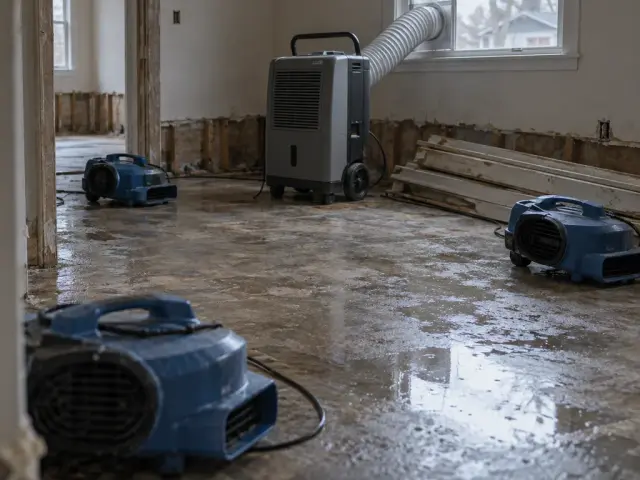
Emergency mitigation — extraction, equipment, moisture readings, removal of material that cannot be saved — is one job. Repair and rebuild is another, and it follows later with different numbers. Keeping them apart makes both easier to settle and makes it obvious what was done under time pressure.
Ask for the mitigation invoice to be itemised by equipment and days. Standing equipment is charged per day it is there, and a vague total is where disputes about drying time begin.
Tell the insurer the same day
Open the claim as soon as the water is stopped, before the crew arrives if possible. Policies require prompt notice, and while the word is vague, the practical standard is the same day or the next. Say that emergency mitigation is starting and ask them to confirm that in writing.
Nothing about opening a claim commits you to making one. It records the date, which is the part that matters if the damage turns out to be worse than it looked.
What the contractor cannot do for you
A restoration contractor dries buildings. Negotiating your claim, valuing your loss or arguing coverage with your insurer is adjusting, which is a licensed activity in many states and not something a drying crew may do on your behalf.
A contractor documenting their own work — readings, photographs, equipment logs — is ordinary and useful. A contractor offering to handle your claim is offering something different, and it is worth understanding which one is on the table.
Who authorises what
Emergency work still needs someone with authority to sign for it.
- 01You own and live here. Authorise mitigation immediately and open the claim the same day. Keep the two conversations separate and both in writing.
- 02You own it and rent it out. Your tenant cannot authorise work on your building. If you are not reachable, that delay is the damage, so give a managing agent standing authority before you need it.
- 03You live in a flat or condo. Establish quickly which parts are common property. Mitigation inside your unit is usually yours to authorise even when the source was not.
- 04You rent here. Report it and let the owner authorise. Do not sign for building work; you may be held to it.
Connects you with an independent contractor about new work. Calls may be recorded.
What to ask before you agree to anything
Ask these of whoever turns up. A contractor who answers them plainly is the one you want; a contractor who will not is telling you something.
- 01Is your mitigation invoice separate from any repair work, and can I see the format?
- 02How is equipment charged, and how many days do you expect it to stand?
- 03What will you give me to send to my insurer, and when?
- 04Do you need anything signed today, and what exactly does it commit me to?
- 05What happens if the insurer questions the drying time?
- 06What is your licence number and who issued it?
Have this ready before you call
Three facts move the first minute past the formalities: what happened, when it started, and whether water is still moving. These add the detail that decides what gets loaded on the van.
- Your insurer and policy number
- The time you discovered the water and the time it was stopped
- Whether you have opened a claim yet
- Photographs from before anything was moved
- Who is authorised to sign for work on the property
- Whether the property is occupied while drying runs
Connects you with an independent contractor about new work. Calls may be recorded.
Where these figures come from
Every number on this page is published by someone other than us, and each link goes to their own text rather than to a summary of it.